Beyond the Guidebooks: Exploring Zhangye Danxia
I’ve seen enough heavily edited travel photos to be instinctively skeptical. So, when images of Zhangye Danxia’s “Rainbow Mountains” first popped up on my feed – those impossibly striated, multi-hued geological formations in China’s Gansu province – my immediate, default reaction was a mental eye-roll. Surely, no landscape on earth naturally looks like it was painted by a hyperactive preschooler with a penchant for primary colors and a complete disregard for subtlety? These had to be the work of digital manipulation, the kind of Instagram bait that looks stunning on a screen but leaves you thoroughly underwhelmed in person, feeling like you’ve been conned into a long journey for a dull reality.
But Zhangye Danxia had lodged itself in my mind, a logistical challenge I couldn’t quite shake. The sheer audacity of the colors. It started feeling less like a digital trick and more like a puzzle to solve: how to actually get to a place that looks so unreal, and what would the day-to-day experience of being there entail?
The Unfiltered Reality
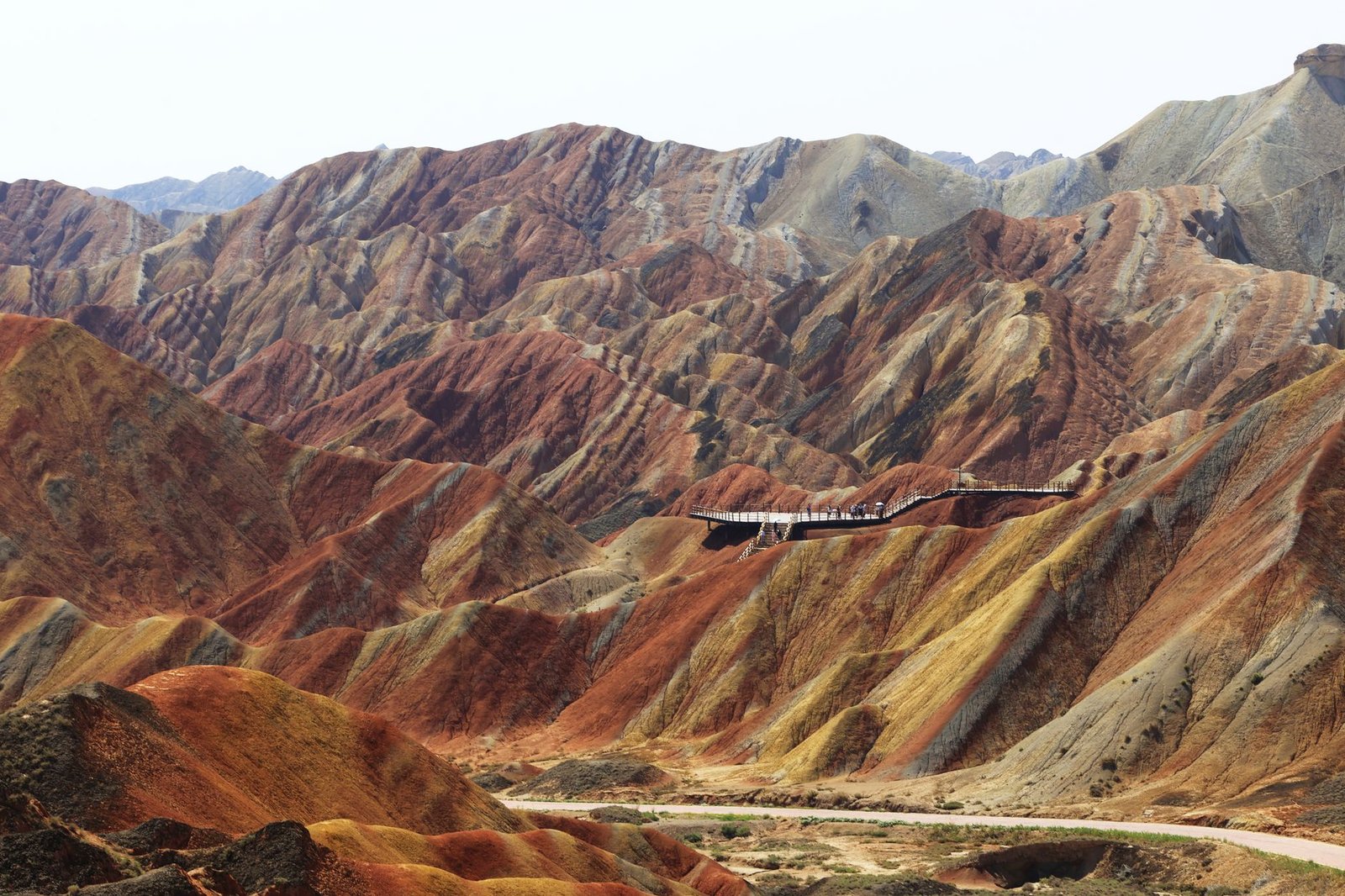
Stepping onto the boardwalks of the Zhangye Danxia National Geological Park, the skepticism evaporated. Immediately. The colors are, in fact, real. Unedited. And utterly breathtaking in a way that no photograph, no matter how skilled, can truly capture. The scale of it, up close, is what the photos miss. It’s not just a collection of pretty hills; it’s a vast, sprawling landscape where layers of sandstone and mineral deposits, compressed and uplifted over 24 million years, reveal themselves in bands of crimson, ochre, rust, sage green, and even deep violet. The effect is less a painting and more a geological treatise laid bare, stretching to the horizon.
My first thought wasn’t about the beauty, though it was undeniable. It was about the logistics of preservation and access. The park is well-managed. There are extensive, well-maintained boardwalks that guide you through various viewing platforms, ensuring minimal impact on the fragile formations while offering excellent vantage points. This is not a place for off-trail exploration, and rightly so. Shuttle buses efficiently ferry visitors between these platforms, which, from a practical standpoint, makes navigating the vast park surprisingly straightforward and less physically demanding than one might expect for such a dramatic natural site.
Daily Life in the Rainbow Landscape
Watching the light shift across the formations throughout the day becomes its own kind of mesmerising routine. The colors deepen, soften, or sharpen depending on the sun’s angle, transforming the landscape with every passing hour. It’s a testament to the fact that even in such a visually stunning location, the rhythm of daily life and natural phenomena still dictates the experience.
From a remote worker’s perspective, connectivity here is surprisingly robust. Decent cellular coverage meant I wasn’t entirely cut off, which is always my primary concern when planning remote sprints to less-explored corners of the world. While I wasn’t trying to conduct high-bandwidth video calls from the viewing platforms, routine checks and communications were perfectly feasible, allowing for that crucial balance between experiencing the extraordinary and maintaining some semblance of my usual schedule.
Practical Basics, Sorted
For those considering a trip, timing is everything. The generally accepted best time to visit Zhangye Danxia is between June and September. From a practical standpoint, this window typically offers the most favourable weather conditions – clearer skies and less chance of sandstorms – which are crucial for both comfortable exploration and for seeing the colors at their most vibrant. Overcast days can mute the visual impact, so aiming for sunny periods is advisable.
Getting to Zhangye itself typically involves flying into Lanzhou (Lanzhou Zhongchuan International Airport, ZGC) and then taking a high-speed train, which is an efficient and comfortable way to cover the distance. Once in Zhangye city, taxis or local tours can easily take you to the park entrance, which is about an hour’s drive away. While the park is clearly a major tourist draw, it doesn’t feel overwhelmingly crowded outside of peak national holidays, thanks to its sheer size and the efficient management of visitor flow.
Regarding overall costs, China can be surprisingly affordable once you account for the initial flight. Accommodation in Zhangye city offers a range of options, from budget-friendly guesthouses to more comfortable hotels. Local food is delicious and generally inexpensive. The primary expenses will be your international flights, internal travel, and the park entrance fee, which, for a natural wonder of this magnitude, feels like a reasonable investment.
As with all travel to China, a valid visa is required for most nationalities. This is an administrative step that needs to be planned well in advance, usually requiring an application through a Chinese embassy or consulate in your home country. It’s a standard procedure, but one that demands attention to detail and timing, as spontaneous travel isn’t typically an option.
Is It Worth the Logistical Effort?
So, does Zhangye Danxia actually work day to day? Does it justify the journey and the administrative hurdles? Absolutely. This isn’t just a destination; it’s a profound geological spectacle, a place that actively challenges your perceptions of what “natural” beauty can look like. It’s a reminder that sometimes, the most astonishing realities are the ones that initially seem too good to be true. The logistics are manageable, the infrastructure is in place, and the reward is a landscape that truly defies description, delivering on its promise of an unfiltered, vibrant reality.
Plan your trip with TourZen.in – real itineraries, trusted local experts, one simple conversation.
Image by: daydream\nhttps://www.pexels.com/@daydream-753072845