A Slow Traveler’s Notes from Eguisheim
The air, crisp and carrying the faint sweetness of grapevines and something ancient from the earth itself, wrapped around me the moment I stepped into Eguisheim. I’d read, of course, about its unusual design, but to stand here, on the very edge of its concentric embrace, felt like stepping into a living diagram. The village unfurls not in a grid, nor along a meandering stream, but in perfect, protective rings, each timbered house a segment of a larger, perfectly formed circle, all drawing the eye inexorably inward to the weathered stones of the medieval castle keep.
First Impressions: The Village as a Walled Garden
This isn’t just a pretty village; it’s a statement, a philosophy etched in stone and wood. My first instinct was to simply walk, to trace the outermost circle, letting the rhythm of the cobblestones guide me. And what a walk it was. Each half-timbered house, painted in a cheerful palette of ochre, sage, and sky blue, seemed to vie with its neighbour for the most abundant cascade of geraniums. The effect is one of continuous, blooming beauty, a visual lullaby that makes you slow down, almost against your will.
The genius of Eguisheim’s medieval planners becomes immediately apparent. This circular layout, called a “castrum” design, wasn’t for aesthetic pleasure alone but for protection. Imagine the winding, narrow paths, the unexpected turns, all designed to disorient an invader, to make every step a puzzle. For a traveler like me, it’s a delightful maze, a constant invitation to peek into courtyards and discover hidden archways. It feels less like a town and more like a carefully constructed, very old, and incredibly charming fortress.
Getting Oriented: Following the Rings to the Heart
Finding one’s bearings here is less about consulting a map and more about submitting to the flow. The streets, named Grand Rue and Rempart, gently curve, mirroring the defensive walls they once were. You find yourself moving naturally, pulled deeper into the village’s core. The château, though largely ruined now, still stands with a quiet dignity, its thick walls bearing witness to centuries. It was once the seat of the Counts of Eguisheim, a lineage that famously gave the world Pope Leo IX in the 11th century. To walk these paths is to walk in the footsteps of such history, feeling the weight of time not as a burden, but as a deep, resonant hum beneath your feet.
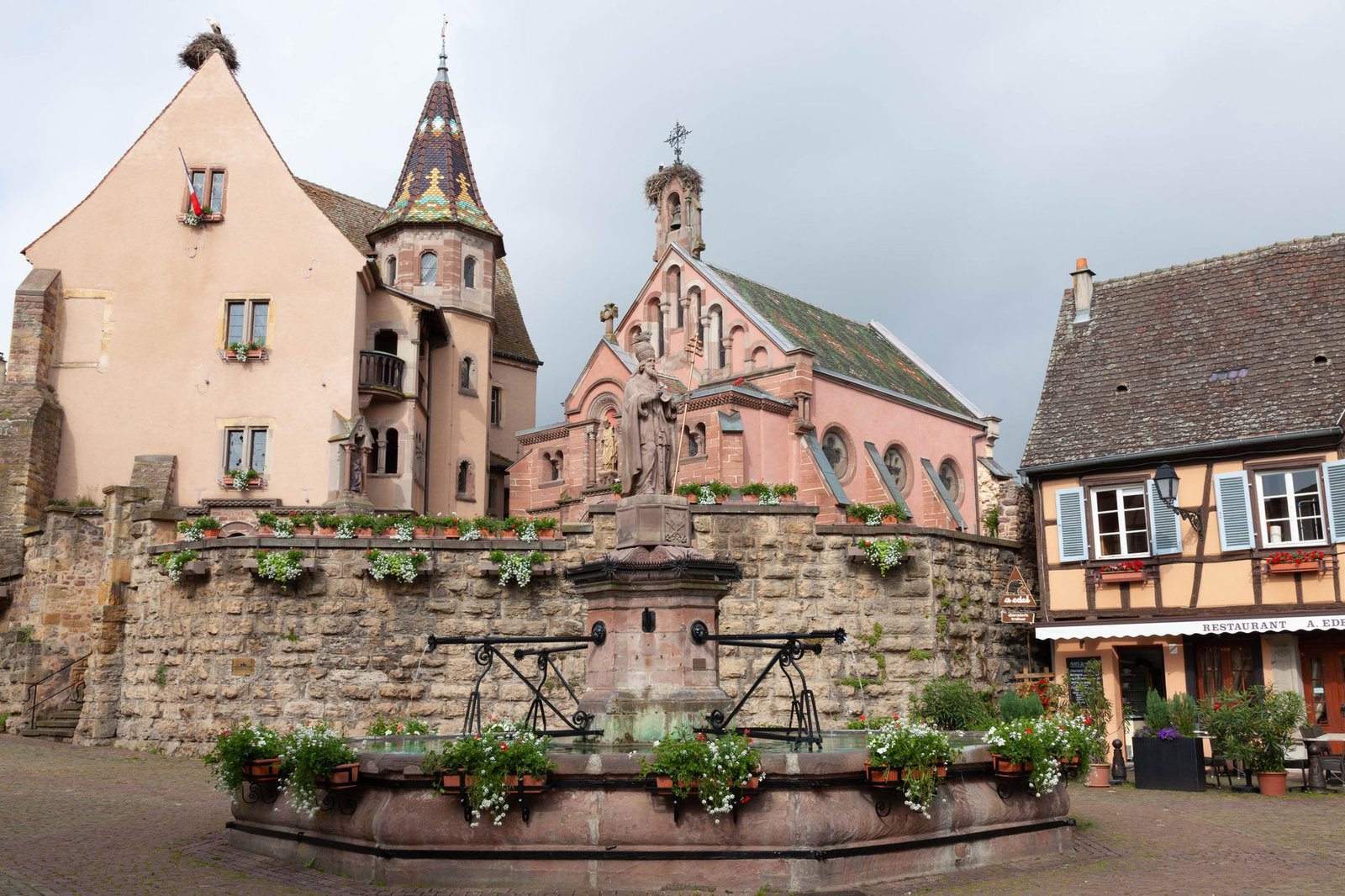
I found myself repeatedly drawn to the central square, dominated by the castle and a charming fountain, crowned by a statue of Pope Leo IX himself. This is where the rings meet, where the defensive layers converge. It’s a place of convergence, not just geographically, but historically and culturally. One can almost hear the echoes of medieval market days, the clatter of armour, the whispers of village gossip carried on the Alsatian breeze. The history here isn’t locked away in a museum; it lives in every stone, every beam, every window box.
A Standout Moment: The Story in the Stones
One afternoon, I sat on a low stone wall, just off one of the inner rings, watching a woman carefully tending her window boxes. Her movements were slow, deliberate, as if she were engaged in an ancient ritual passed down through generations. A stray cat, sleek and black, wound its way through the narrow gap between houses, disappearing into a shadowy alleyway that promised forgotten corners.
It was in that quiet moment, with the scent of damp earth and blooming petunias in the air, that the true magic of Eguisheim settled over me. It wasn’t just the picturesque beauty, but the profound sense of continuity. This village, with its unique, defensive embrace, has sheltered lives for a millennium. The folklore isn’t just tales; it’s the very structure of the place. The concentric rings, to Latha, are like the rings of an old tree, each layer telling a story of growth, resilience, and quiet, enduring life. It’s a tangible link to a past where community and protection were woven into the very fabric of existence.
Practical Grounding: Embracing the Eguisheim Pace
Eguisheim thrives on a slower pace. It’s a destination for those who wish to wander, to truly absorb their surroundings rather than tick off a list. The village is particularly enchanting from April to October, when the flowers are in full riotous bloom and the vineyards surrounding the village are at their most vibrant. Should you wish for a touch of winter magic, December offers a charming Christmas market, transforming the already quaint streets into a festive wonderland.
Navigating Eguisheim is entirely done on foot; the car park is located just outside the village’s core, preserving its pedestrian charm. In terms of safety, Eguisheim is exceptionally welcoming and calm, a place where one feels utterly at ease wandering its quiet lanes even after dusk. Costs are typical for a popular Alsatian wine village – you’ll find charming guesthouses and restaurants catering to a range of budgets, though prices can climb during peak seasons and festivals.
Summary
Eguisheim is more than just another pretty Alsatian village; it is an architectural marvel, a living testament to medieval ingenuity, and a sanctuary for the slow traveler. Its circular design, radiating from the ancient castle keep, is not merely a curiosity but the very heart of its character, dictating its rhythm and revealing its history with every curved street and flower-draped facade. For those who seek beauty, history, and a gentle respite from the rush of the world, Eguisheim offers an embrace unlike any other.
Plan your trip with TourZen.in – real itineraries, trusted local experts, one simple conversation.
Image by: PHILIPPE SERRAND\nhttps://www.pexels.com/@philippe-serrand-337910945