Ferrara: Flat, Friendly, and Far Better Than I Expected?
Before I landed in Ferrara, all I really knew was that it was *flat*. Which, in Italy, immediately made me suspicious. Flat? In a country famed for its dramatic, vertiginous hill towns, where every panorama seems to demand a calf-burning ascent? My internal cynical travel writer alarm was blaring, expecting some kind of bland, modern sprawl that had somehow escaped the hilly memo. I braced myself for a decent, but ultimately forgettable, stop in the Po Valley. Turns out, I was spectacularly wrong. Ferrara, with its red-brick majesty and pervasive bicycle culture, isn’t just a “nice” place; it’s genuinely special, a quiet assertion of Renaissance grandeur that doesn’t feel the need to shout about it.
What’s Ferrara actually like? Is it just… flat?
When I pictured an Italian city, it was always a kaleidoscope of narrow, winding streets, steep climbs, and sun-baked piazzas. Ferrara, I’d read, was different. And my initial thought was, “different good, or different *boring*?” Thankfully, it’s the former. This isn’t just “flat,” it’s a meticulously preserved Renaissance city that decided long ago that bicycles were the superior mode of transport. Everywhere you look, people are cycling – grandmothers with market baskets, students zipping to class, couples on leisurely evening rides. It gives the city an incredibly relaxed, almost gentle pace that’s a stark contrast to the usual Italian bustle.
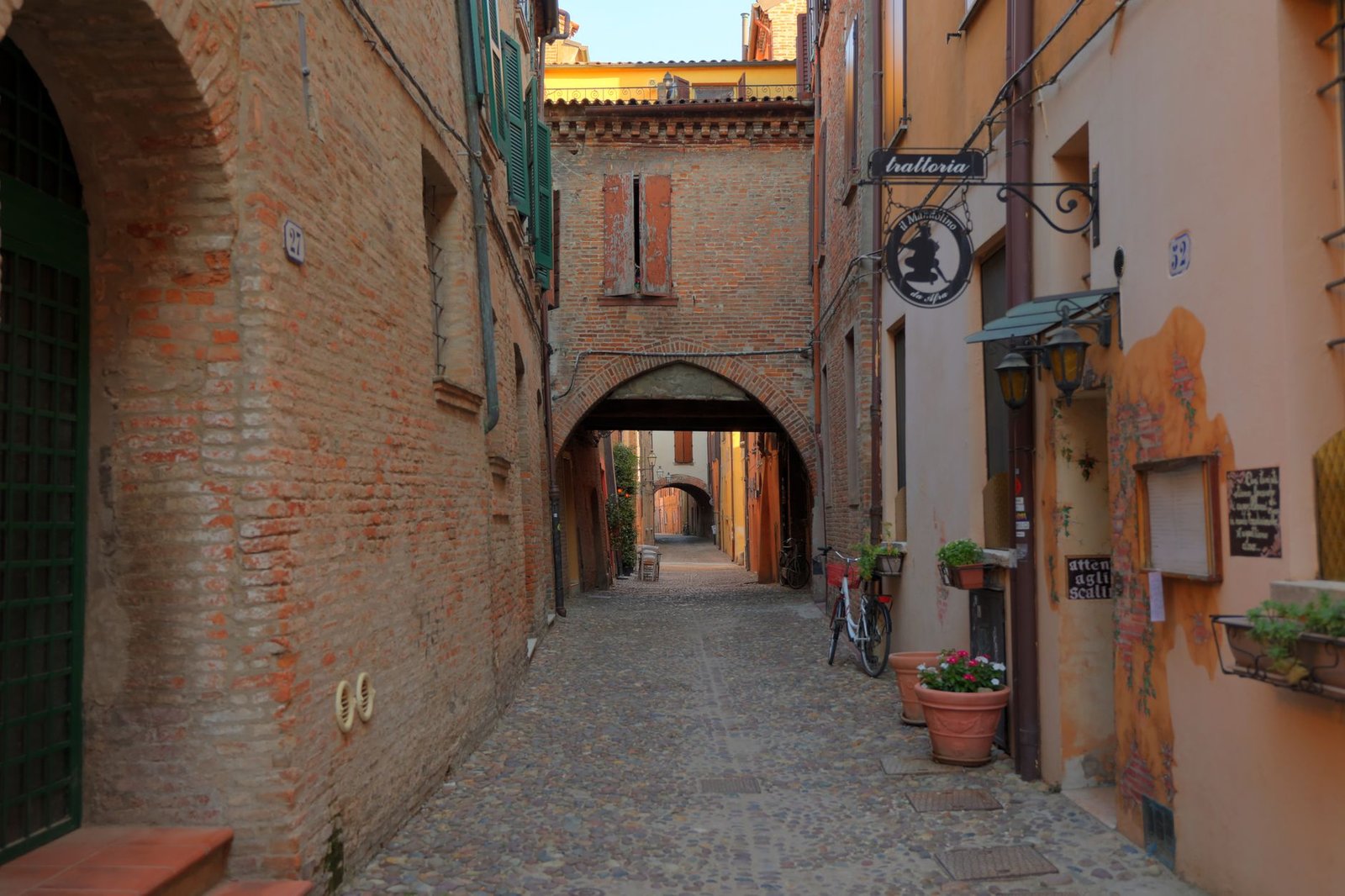
The architecture itself is a revelation. I was expecting more of the usual pale stone, but Ferrara is a city built of brick. Deep, earthy red bricks that glow in the sun and take on a soft, historic hue as evening falls. The mighty Este dynasty, who ruled here for centuries, left behind an incredible legacy of brick palaces and fortifications, creating a distinct aesthetic that feels uniquely Ferrarese. It’s less about dramatic vistas and more about discovering beauty in the details – the intricate patterns in the brickwork, the quiet courtyards, the sense of history echoing down cobbled (but mostly flat) lanes. It’s the kind of place that slowly, quietly, wins you over.
So, is it *really* that cycle-friendly, and what’s there to see on two wheels?
Absolutely. The online buzz about Ferrara being a cycling paradise? It’s not hype. It’s the truth. You’ll rent a bike almost immediately upon arrival – everyone does – and it instantly transforms your experience. Forget waiting for buses or hailing cabs; you simply glide. The entire historic centre is virtually car-free, and even outside the walls, dedicated bike paths make getting around a breeze.
The main draw, undoubtedly, is the imposing Castello Estense, a proper moat-encircled, four-towered fortress that just erupts from the city centre. Cycling around its perimeter, or parking up to explore its interiors, feels completely natural. Then there’s the Duomo, a striking Romanesque-Gothic cathedral that stands proudly in the heart of the city, its façade a captivating mix of styles.
But for me, the real joy was cycling the city walls. Ferrara boasts an almost perfectly preserved circuit of medieval and Renaissance walls, stretching for nine kilometres. They’ve been beautifully converted into a tree-lined promenade, offering uninterrupted views of the city on one side and the surrounding countryside on the other. It’s an incredible experience to just cruise along, soaking in the history without breaking a sweat, a luxury you just don’t get in most Italian cities. You can easily spend an entire afternoon just exploring the walls and the quiet, leafy streets just inside them.
What are the essential sights I shouldn’t miss?
Beyond the unmissable Castello Estense and the grand Duomo, Ferrara offers a handful of truly captivating spots that really cement its place as a hidden gem.
The Palazzo dei Diamanti is one of those places that looks exactly as its name suggests – its entire exterior is covered in over 8,000 diamond-pointed marble blocks. It’s a striking piece of Renaissance architecture and houses the Pinacoteca Nazionale, a national art gallery that’s worth a quiet hour or two, especially if you appreciate local Renaissance masters.
Another spot I really enjoyed was the Jewish Ghetto. Tucked away near the Duomo, its narrow, ancient streets and historic buildings offer a poignant glimpse into centuries of Jewish life in Ferrara. It’s a very different feel from the grand Este palaces, providing a richer, more layered understanding of the city’s past. And don’t forget to simply wander, getting lost in the grid-like streets designed by Biagio Rossetti, one of Europe’s first urban planners. It’s a city made for exploration, not just ticking off a list.
When’s the best time to roll into town?
I’d always check the calendar for this kind of trip, and Ferrara’s no different. The sweet spot, avoiding the scorching heat of peak summer and the chill of winter, is definitely **April to June** and then again in **September to October**.
The spring months offer pleasant temperatures for cycling and exploring, with the city’s many parks and green spaces coming alive. Plus, you’ll catch various local festivals without the overwhelming crowds. Autumn, likewise, brings comfortable weather and a gorgeous quality of light that makes the brick architecture glow even more. The summer can be quite hot, especially in the Po Valley, which can make extended cycling less enjoyable. Winter, while quieter, can be foggy and damp. Stick to spring or autumn, and you’ll be golden.
Is Ferrara worth the detour, or just another stop on the map?
This is the big question, isn’t it? My expectation, as I said, was pretty low. I thought it would be a pleasant enough interlude, a place to stretch my legs between more “iconic” Italian destinations. But Ferrara genuinely surprised me. It’s not trying to be Florence or Venice; it has its own distinct, quiet confidence.
It’s worth the detour precisely because it *isn’t* swarming with tourists. You get to experience a living Italian city that’s deeply proud of its history but isn’t overly commercialized. The cycling culture creates an immediate connection to the place, making you feel less like an observer and more like a temporary resident. If you’re looking for a slower, more authentic taste of Italian history, a place where Renaissance art and urban planning truly blend, and where you can genuinely relax and explore at your own pace, then yes, Ferrara is absolutely worth making a special trip for. It’s a genuinely rewarding experience that reshaped my rather cynical expectations of Italian “hidden gems.”
Any practical tips for visiting Ferrara?
Getting to Ferrara is relatively straightforward; it’s well-connected by train from major hubs like Bologna, Venice, and Florence. Once there, your best bet for getting around, as I’ve hammered home, is a bicycle. Rental shops are plentiful and reasonably priced.
Costs in Ferrara tend to be more moderate than in the bigger, more famous Italian cities. Accommodation, food, and attractions are generally a bit gentler on the wallet, which is always a welcome surprise. Safety-wise, it feels incredibly secure – the laid-back atmosphere extends to a general sense of calm and order. Basic Italian phrases will always be appreciated, but you’ll find English speakers in tourist-centric areas. Embrace the slower pace, linger over an aperitivo in a quiet piazza, and allow yourself to simply *be* in this wonderfully understated city. You might just find it exceeding your expectations too.
Plan your trip with TourZen.in – real itineraries, trusted local experts, one simple conversation.
Image by: Gildo Cancelli\nhttps://www.pexels.com/@mmg-cancelli